

Curriculum mapping refresh: from assessment tagging to continuous quality improvement
Curricula change continuously. A course adds new content. Faculty revise an assessment. Learning outcomes evolve. Accreditation standards change. An exam item gets reused without being retagged to reflect what it now measures.
Over time, these small changes can create a disconnect between what a curriculum map says is happening and what students are actually being taught and assessed on.
A curriculum mapping refresh helps programs address that drift before another cycle of assessment data accumulates.
The goal isn’t simply to update a map for accreditation. It’s to make sure the relationships among learning outcomes, competencies, assessments, curricular experiences, and current standards are clear enough to support meaningful faculty decisions and continuous quality improvement (CQI).
For programs beginning a new academic or assessment cycle, a practical refresh follows four steps:
- Revisit
- Tag & validate
- Map & interpret
- Act & document
Why refresh your curriculum map at the start of a new cycle?
Health professions programs don’t all follow the same academic calendar. New cohorts, rotations, clinical experiences, semesters, and assessment cycles begin at different times.
But the start of a new cycle creates a useful opportunity to ask:
Does our curriculum map still reflect what we’re actually teaching and assessing?
A few warning signs suggest it may be time for a refresh:
- Course or program learning outcomes no longer reflect current curricular expectations.
- Faculty interpret assessment categories differently.
- Accreditation or competency frameworks have changed since the map was last reviewed.
- Assessment items have been revised or reused without corresponding updates to their tags.
- Gap analysis depends more on institutional memory than systematic assessment evidence.
None of these necessarily signals a curriculum problem. But they may indicate that the evidence connecting curriculum, assessment, and outcomes needs attention.
Maintaining that alignment makes it easier to support ongoing program review and demonstrate continuous improvement without reconstructing the evidence immediately before an accreditation review.

Step 1: Revisit your category definitions
Consistent category definitions are the foundation of useful learning outcomes mapping and competency-based assessment tagging.
Before applying AI, or any technology, faculty need to agree on what those categories mean for their program.
Depending on the discipline, that might include:
- Program and Course Learning Outcomes
- Professional competencies
- Accreditation standards
- Bloom’s Taxonomy
- Discipline-specific frameworks and examination blueprints
For pharmacy programs, for example, categories may include ACPE Appendix 1, the NAPLEX® Blueprint, IPEC competencies, Bloom’s Taxonomy, and program-specific outcomes.
💡 The goal isn’t to tag against everything possible. It’s to select categories that help faculty answer meaningful questions about student learning and curriculum performance.
The free Category Tagging Toolkit from Enflux provides a practical framework for deciding what to tag, who should participate in tagging decisions, when tagging should occur, and how to maintain consistency.

Step 2: Tag & validate assessment evidence at scale
Assessment tagging is one layer of curriculum mapping, not the entire map. A complete picture may also include courses, clinical or experiential learning, simulations, assignments, competencies, outcomes, and other direct and indirect evidence.
Item-level tagging adds valuable detail by helping faculty answer:
Where and at what level are our intended competencies actually being assessed?
Manual review remains important for establishing definitions and applying academic judgment. The challenge is maintaining consistency when the same framework needs to be applied across thousands of assessment items and multiple years of data.
That’s where AI-powered curriculum mapping and assessment tagging can help.
CompetencyGenie™ by Enflux applies program-selected categories across assessment items at scale. For programs using ExamSoft, it integrates with existing assessment data so teams can work with items already in their assessment environment.
The goal isn’t to delegate curricular judgment to AI. Faculty define the categories and can review and refine AI-generated tags; AI reduces the repetitive work required to apply those decisions at scale.
Without CompetencyGenie™
With CompetencyGenie™
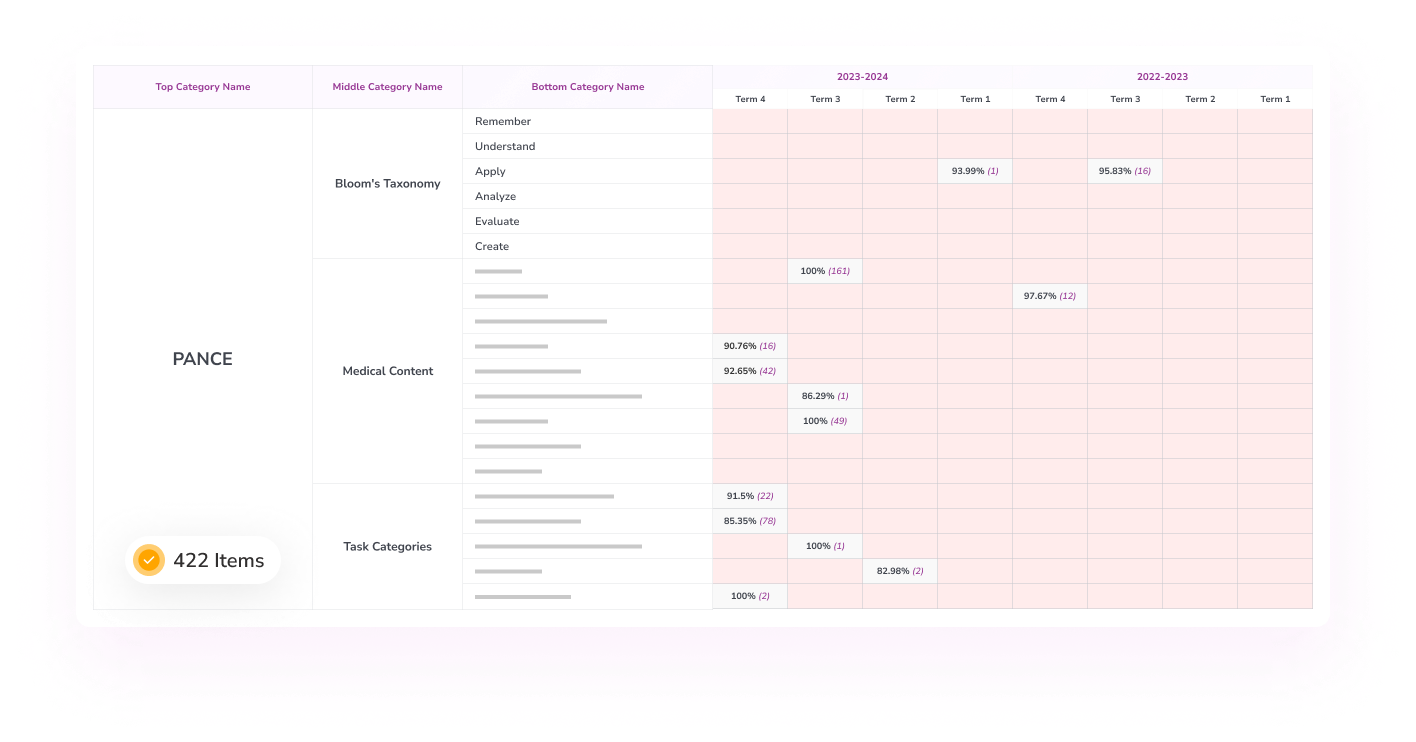
Before CompetencyGenie™

Limited assessment data
The institution faced challenges in evaluating its curriculum effectively due to having only 422 tagged exam items, resulting in an incomplete and potentially inaccurate understanding of program effectiveness.
Perceived curriculum gaps
With limited data, the curriculum appeared to have numerous gaps, making it challenging to identify specific areas needing improvement.
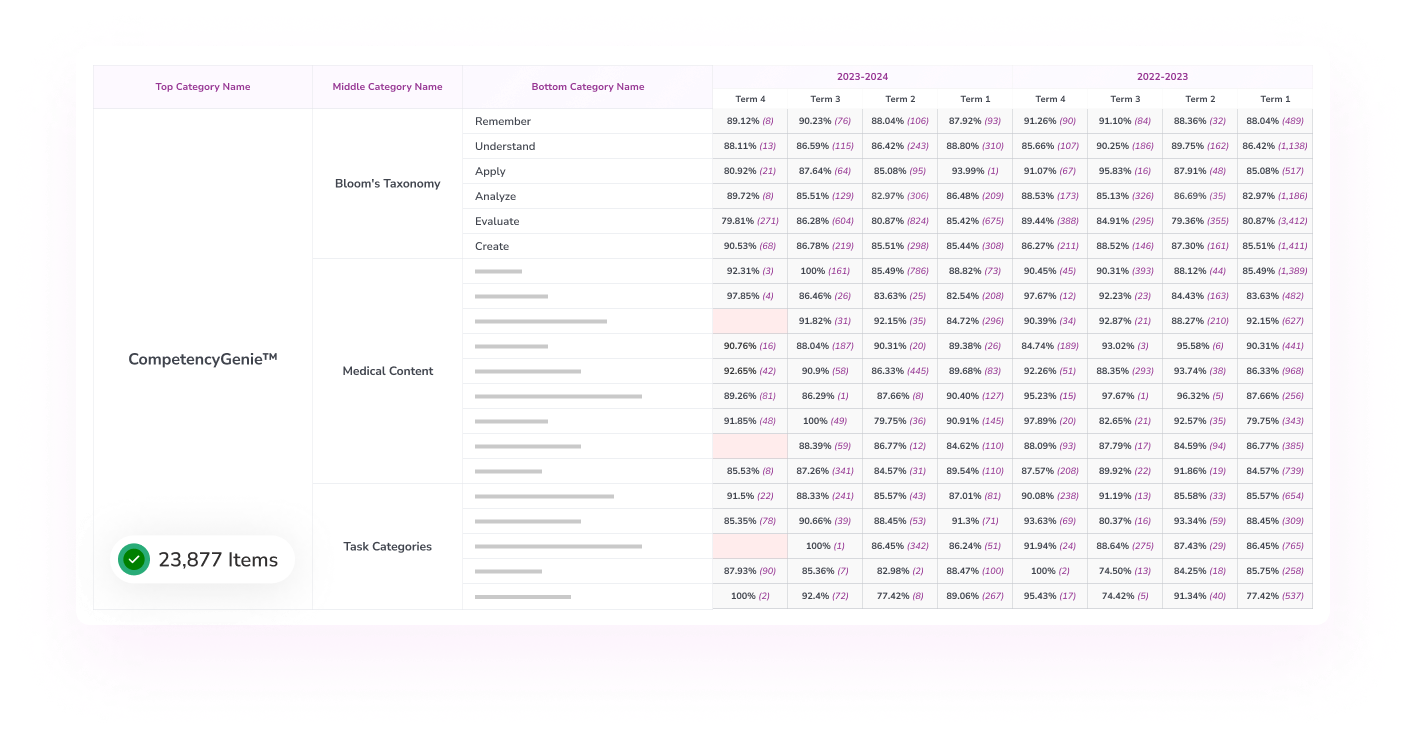
After implementing CompetencyGenie™

Extensive assessment data
The institution now benefits from a robust dataset, with 23,877 tagged exam items, enabling a comprehensive and precise evaluation of the curriculum.
Accurate gap identification
With the significantly increased data, the institution accurately identified only 3 gaps in the current academic term, allowing for timely corrective actions and ensuring a cohesive curriculum by the term’s end.
Efficient self-study preparation
Detailed reports generated well in advance of self-study submissions have saved the institution countless hours of manual tagging and report creation, streamlining the accreditation process.
Enhanced focus on improvement
CompetencyGenie™ has automated the labor-intensive tasks of data cleaning and tagging, thereby allowing faculty to concentrate on their primary objective—identifying and enhancing areas within the curriculum.
From 422 tagged items to 23,877
At The University of Texas at Austin College of Pharmacy, faculty had manually tagged approximately 422 assessment items.
With CompetencyGenie™, the program expanded tagging to 23,877 items, creating a substantially more complete dataset for curriculum analysis. That broader coverage helped the program narrow its analysis to three identified curriculum gaps.

“This is so easy to download and get started using this tool. The video was very informative and the whole process was intuitive. I tested a few questions for accuracy and I agreed with the results. I am excited to use this more!”
Ashley Castleberry, Pharm.D., M.Ed
Assistant Dean for Curriculum and Assessment Division Head and Clinical Associate Professor of Pharmacy Practice | The University of Texas at Austin College of Pharmacy
💡The value isn’t simply faster tagging. Greater assessment coverage gives faculty a stronger evidence base for deciding where deeper curriculum review may be needed.
Step 3: Map and interpret what the evidence shows
More tagged data doesn’t automatically produce better decisions. Faculty still need to interpret what the patterns mean.
A refreshed curriculum map can help programs investigate questions such as:
- Where are competencies introduced, reinforced, and assessed?
- Are some outcomes assessed heavily while others have limited evidence?
- Where are the gaps or unnecessary redundancies?
- Do assessment levels reflect expected student progression?
- Does the evidence support what faculty believe is happening in the curriculum?
This is where curriculum mapping moves beyond documentation and becomes a decision-support process.
Instead of simply asking, “Where does this competency appear?” faculty can ask:
“What does our evidence tell us about how students encounter and demonstrate this competency?”
Step 4: Turn findings into documented improvement
Finding a curriculum gap isn’t the end of the assessment process. It’s the beginning of a faculty decision.
Teams still need to determine whether the finding requires action, what may be causing it, who owns the response, and how they’ll know whether a change worked.
That’s the connection between curriculum mapping and CQI in higher education:
- Where are competencies introduced, reinforced, and assessed?
- Are some outcomes assessed heavily while others have limited evidence?
- Where are the gaps or unnecessary redundancies?
- Do assessment levels reflect expected student progression?
- Does the evidence support what faculty believe is happening in the curriculum?
This is where curriculum mapping moves beyond documentation and becomes a decision-support process.
Instead of simply asking, “Where does this competency appear?” faculty can ask:
“What does our evidence tell us about how students encounter and demonstrate this competency?”
- Evidence
- Interpretation
- Decision
- Action
- Reassessment
A gap in tagged assessment data, for example, might reflect insufficient curricular coverage. But it could also indicate an assessment-design issue, inconsistent tagging, or incomplete evidence.
💡Technology can surface the pattern. The faculty determines what it means.
Once a decision is made, programs also need to document the evidence reviewed, rationale, action, owner, measure of success, and point for reassessment.
Enflux’s ActionPlans® Management System helps programs connect those decisions to their assessment evidence and track follow-through over time—rather than leaving improvement activities scattered across committee minutes, spreadsheets, and shared drives.
“You can make your committee meetings more effective by communicating through these ActionPlans®, closing that assessment loop, and helping close the communication loop.”
Dr. Kristy Lucas
Dean and Professor, University of Charleston School of Pharmacy

Your four-step curriculum mapping refresh
For your next academic or assessment cycle:
- Revisit. Confirm your outcomes, competencies, standards, and category definitions.
- Tag & validate. Apply those definitions consistently across relevant assessment evidence, using AI-assisted tagging where scale makes manual categorization impractical.
- Map & interpret. Examine coverage, progression, gaps, and redundancies, and bring faculty judgment to what the evidence reveals.
- Act and document. Translate meaningful findings into action plans with ownership, measures of success, and a defined point for reassessment.
The goal isn’t simply a refreshed curriculum map.
It’s a repeatable process that connects:
- Curriculum
- Assessment
- Outcomes
- Decisions
- Improvement
Enflux supports that process by bringing together curriculum mapping, gap analysis, AI-assisted assessment tagging through CompetencyGenie™, learning analytics, and documented follow-through with ActionPlans®.
The result is a more connected view of what is being taught, assessed, reviewed, and improved, and stronger evidence for both academic decision-making and accreditation readiness.
Bring your curriculum and assessment evidence into one connected view
See how Enflux can help your team scale assessment tagging, strengthen learning outcomes mapping, identify curriculum gaps, and turn findings into documented continuous improvement.