

Faculty workload estimator: what a national pharmacy study found
Faculty workload is one of the most persistent and least standardized challenges in pharmacy education. It is rarely measured the same way across departments or distributed equitably; some effort is “hidden” or unaccounted and never makes it onto a spreadsheet. If left unmanaged, it can quietly derail promotion timelines, faculty wellness, and retention.
In this Enflux panel discussion, Gloria Grice, Pharm.D., BCPS, FNAP, Associate Dean for Academic Affairs and Professor of Pharmacy Practice at St. Louis College of Pharmacy (UHSP); Lisa Lebovitz, JD, MS, Assistant Dean of Academic Affairs and Assessment at the University of Maryland School of Pharmacy; and Sharon K. Park, PharmD, MEd, BCPS, Associate Dean for Academic Affairs & Assessment at Notre Dame of Maryland University, discuss the national pilot study behind the Faculty Workload Estimator (FWE).
They cover what the data revealed about hidden workload, and how programs can use it to have more equitable, evidence-based conversations about faculty capacity.

The problem with faculty workload and what a national study revealed
Enflux: Before we get into the study, what are the recurring problems you see in how pharmacy programs measure faculty workload?
Gloria Grice: Workload usually isn’t measured consistently. It might be tracked within a department, but not the same way across every faculty member at a college, which is exactly why people so often feel like they’re carrying more than their peers with no way to confirm it.
A lot of real effort also goes hidden: faculty are typically asked to allocate a percentage of their time across different areas, but what they’re allocated to do and what they’re actually doing rarely match. Someone assigned 20% scholarship might really be closer to 10% once everything else is factored in, which directly affects whether they hit their promotion goals.
Additionally, faculty workload has historically been tied to annual reviews. That is why the conversation skews toward productivity rather than effort. We see this constantly with research faculty spending real time on grant writing; not every grant gets funded, but that doesn’t erase the effort that went into it.
Enflux: How did an internal tool turn into a national, multi-institutional study?
Gloria Grice: Those problems are what led us into this work. At St. Louis College of Pharmacy, we’d already spent several years building and refining an internal workload tool. Around the same time, AACP had commissioned a task force between the Council of Deans and Council of Faculties to look at workload. Lisa and Sharon chaired that task force, reviewed a number of existing instruments, and identified ours as a solid one to build on.
ACPE was also updating its accreditation standards right then, and workload turned out to be woven throughout them, so the timing made this an urgent topic for the Academy. Since our tool had only been used within our own institution, Lisa and Sharon proposed testing it by modifying it and opening it up to a much broader group of colleges of pharmacy, which is what became the national pilot.
The goal was to see whether the estimator was useful across pharmacy programs generally, not just within one institution. We trained administrators at participating schools, had them deploy it to their faculty, then studied how both groups felt about it and collected de-identified workload data to see what workload actually looks like across pharmacy education.
The pilot ultimately involved 44 programs and more than 800 faculty members, with results published in the American Journal of Pharmaceutical Education. The sample closely mirrored the real population of pharmacy programs: a near-even public/private split, wide geographic distribution, a representative mix of Carnegie classifications, and faculty spanning every AACP-recognized discipline and rank.

National pilot results: administrator and faculty intent to reuse the Workload Estimator
Enflux: What did the qualitative feedback tell you? What worked, and where did it fall short?
Gloria Grice: Both groups valued the prospective-planning angle, even though most pilot programs actually used the tool retrospectively. They found it genuinely comprehensive, capturing the small tasks that make up hidden workload.
Administrators called it usable, efficient, and a real conversation starter; faculty valued the self-awareness and the ability to benchmark against their peers. Both groups also pushed back on the feeling of ‘bean-counting’ every task, which is a fair critique of any workload process.
“This is exactly why we frame this as an estimator built on averages, not a calculator that audits every hour.”
Gloria R. Grice, Pharm.D., BCPS, FNAPAssociate Dean for Academic Affairs and a Professor of Pharmacy Practice, St. Louis College of Pharmacy, UHSP One of the most valuable byproducts of collecting de-identified data from more than 800 faculty was the ability to establish, for the first time, what normal workload distribution actually looks like across the pharmacy academy.
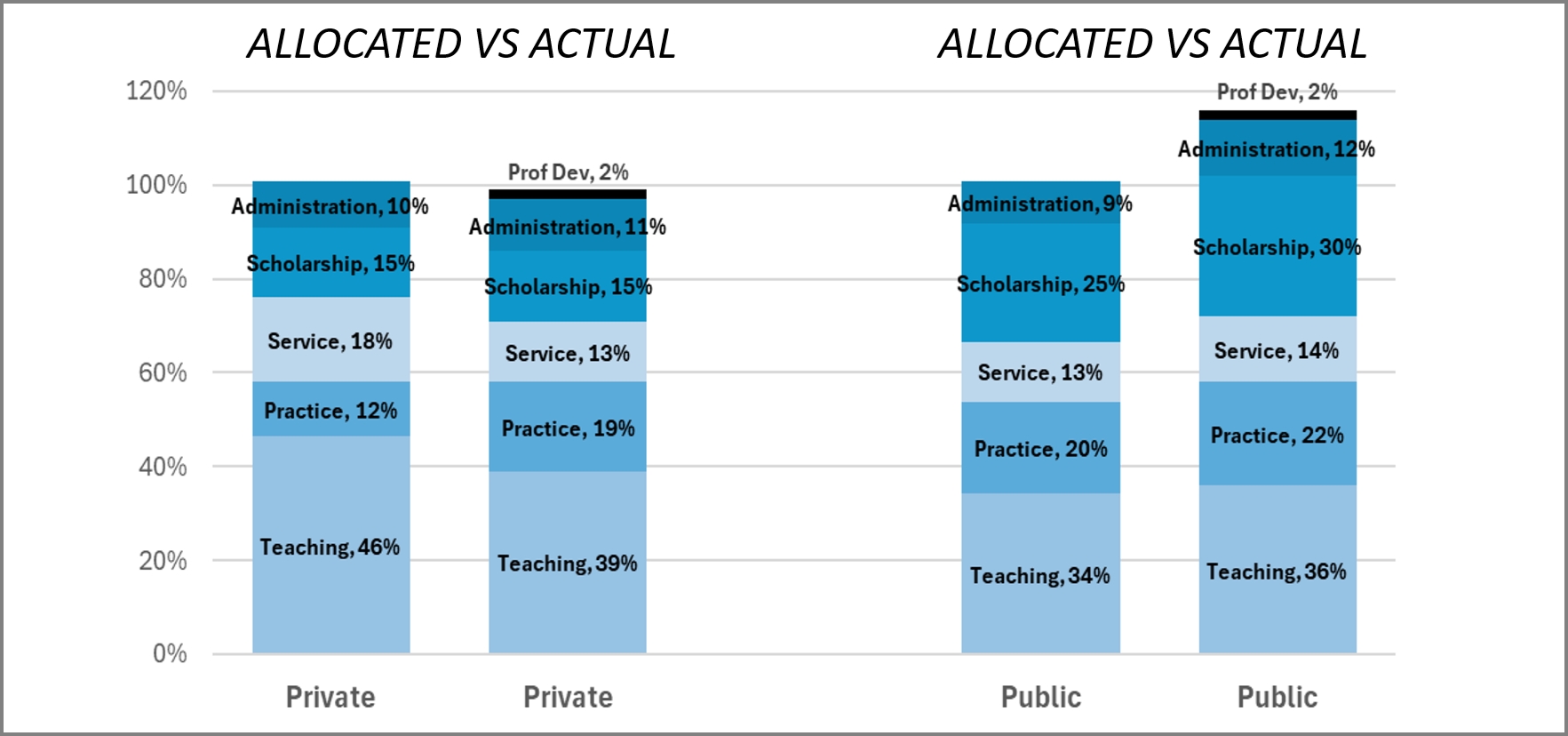
National norms: allocated vs. actual faculty effort by pillar, private vs. public institutions.
Allocated effort and actual effort didn’t line up cleanly, and the gap moved in different directions depending on institution type. These aren’t anecdotes anymore. They’re benchmarked national data programs can use to see exactly where their own numbers diverge from the norm.
Why accreditation standards now put faculty workload center stage
Enflux: Accreditation standards, self-study, substantive changes — why does faculty workload run through all of it?
Lisa Lebovitz: Faculty workload touches accreditation standards, self-study, and substantive change reports more than most people realize.
- Standard 5.1.a expects sufficient faculty capacity across core functions.
- Standard 7.4.d calls for regular assessment of faculty and staff workload.
- Standard 5.2.h requires access to wellness programs to improve their ability to successfully manage and balance work related challenges.
- Substantive change reports require identifying the faculty and staff positions required to fully implement any new initiative, its impact on faculty workload, plans for recruiting more faculty and staff, and mechanisms for faculty development related to the substantive change.
ACPE Standards 5.1.a, 7.4.d, and 5.2.h all put faculty workload data at the center of accreditation readiness. A chair telling a dean “I just need more faculty” isn’t very persuasive on its own.
A well-documented workload picture is the evidence that makes the case.

Building an equitable workload: principles, perspectives, and practical answers
Enflux: Before you can manage workload, how do you even define what’s equitable?
Sharon Park: In 2022, O’Meara and colleagues, under a grant from the American Council on Education, published six principles that give us a strong framework:
- Transparency: faculty understand how workload decisions are made and who does what.
- Clarity: expectations are well-defined, so everyone knows what success looks like.
- Credit: meaningful work is recognized, including advising, mentoring, and committee work that often goes unnoticed.
- Context: faculty have different responsibilities, career stages, and institutional roles, and workload should account for those differences.
- Norms: shared norms give everyone a common understanding of how the department operates.
- Accountability: faculty own and manage their own workload in a way that aligns with institutional priorities.
The key takeaway is simple: equitable workload begins with transparent expectations, not assumptions.
These principles provide a strong foundation, but they’re genuinely hard to put into practice, because faculty and department chairs experience workload from very different vantage points.
Faculty often describe unclear expectations and competing priorities, with new requests constantly pulling their attention away from teaching, scholarship, or clinical practice. Even working long hours, they can feel like they’re not making real progress toward their professional goals.
Chairs, meanwhile, rarely have the complete picture of everyone’s workload at a given moment. They have to balance departmental needs against each person’s strengths and career goals, distribute work fairly, redirect effort as priorities shift, and keep the department’s educational mission moving forward.
Both groups want the same outcome: a successful faculty and a successful institution. They just see workload through different lenses, and that gap surfaces constantly in day-to-day conversations between chairs and faculty.
A workload tool shouldn’t be used as an accountability tool to reconstruct exactly how someone spent every hour of the previous year. And the goal is never for every faculty member’s effort to add up to exactly 100%.
Instead, workload estimates work best as prospective planning tools, giving chairs and faculty a shared framework for discussing expected responsibilities before assignments are finalized, so adjustments can happen before overload sets in and faculty feel genuinely heard.
Used this way, Faculty Workload Estimator helps promote equity across faculty, align responsibilities with expected effort, support wellbeing, and identify who has real capacity for a new initiative or leadership opportunity.
“A faculty workload tool is most valuable when it helps plan future work, not when it's used to judge or relitigate the past.”
Sharon K. Park, PharmD, MEd, BCPSAssociate Dean for Academic Affairs and Assessment and Professor of Clinical and Administrative Sciences, Notre Dame of Maryland University, School of Pharmacy and Health Professions Key takeaways and what's next
Lisa Lebovitz: Don’t launch a new initiative, especially one that requires an ACPE substantive change report unless you already have a good handle on how it will affect faculty workload.
Sharon Park: Have a tool that lets you make evidence-based decisions about workload, and back up conversations with your dean or institutional leadership with real data, not perception. No single tool will satisfy every desire at every institution, but being someone leadership can rely on for consistent, credible data matters enormously.
Gloria Grice: Don’t wait for a perfect instrument. It doesn’t exist. Every workload tool is built on averages. If you hold out for something more precise, you’ll likely never implement anything at all. Keep reframing this as an estimator, not a calculator: a conversation catalyst that gives you objective data.

What began as a single department’s internal spreadsheet at St. Louis College of Pharmacy has grown into a nationally piloted, peer-benchmarked framework for one of pharmacy education’s most persistent problems.
Enflux has continued building on that foundation, developing the Faculty Workload Estimator into an interactive, role-based tool for chairs, deans, and faculty to see exactly what they need. So everybody has workload conversations grounded in shared data instead of assumptions.
Curious how the Faculty Workload Estimator could work for your program?
Schedule a conversation with Enflux to see how it can support your accreditation readiness, faculty wellbeing, and resource planning.