

Curriculum Mapping for PA Programs: From Static Documentation to Curriculum Intelligence
Most physician assistant programs know their curriculum well. Faculty know what is taught, where students build clinical reasoning, and how learners move from didactic coursework into supervised clinical practice experiences.
But when curriculum questions become accreditation questions, the challenge often changes. That is where curriculum mapping for Physician Assistant programs becomes more than documentation. A strong curriculum map gives faculty and program leaders a shared structure for understanding how curriculum design, assessment, and student outcomes connect, identifying gaps and redundancies, aligning with ARC-PA expectations, and supporting continuous self-assessment throughout the year.
This article explains what effective curriculum mapping should accomplish for PA programs, what a useful map should show, where programs commonly get stuck, and how technology can help turn curriculum documentation into ongoing self-assessment.
Why curriculum mapping matters for PA programs
A curriculum map helps a PA program answer one of the most important questions in program evaluation:
Are students being intentionally prepared for the knowledge, skills, and behaviors they are expected to demonstrate?
For PA education, the curriculum map has to do more than list topics. Student performance is rarely explained by one course or one assessment. A weak result in a specific clinical area may reflect a gap in didactic preparation, inconsistent reinforcement across courses, an assessment design issue, or limited opportunity for students to demonstrate competence before entering clinical rotations.
Curriculum mapping also creates a common framework for conversations among course directors, clinical coordinators, assessment committees, and program leadership. With a connected curriculum map, the program can trace where the competency was introduced, where it was reinforced, where mastery was expected, and which assessments produced the evidence. That makes curriculum mapping a foundation for stronger faculty conversations, better assessment design, more transparent accreditation reporting, and more actionable student support.
What an effective curriculum map should show
An effective PA curriculum map should help faculty move from a general sense of coverage to specific, evidence-based answers. It should make the curriculum visible enough that program leaders can evaluate alignment, sequencing, assessment coverage, and student performance patterns without rebuilding the evidence from scratch each time.
A curriculum map should help faculty answer questions such as:
- Which courses, modules, and rotations support each competency?
- Where is each competency introduced, reinforced, and mastered?
- How do assessment items align with the PANCE blueprint and other program frameworks?
- Are students receiving enough opportunities to demonstrate competence before clinical rotations?
- How do course-level outcomes connect to program-level outcomes?
- How does curricular evidence support ARC-PA accreditation and ongoing self-assessment?
- Are there unnecessary redundancies or gaps across the curriculum?
When a map can answer these questions, it becomes a practical tool for curriculum committees, assessment leaders, course directors, and program leadership. It gives the program a shared language for discussing what is taught, what is assessed, and where improvement may be needed.

How technology supports curriculum mapping for PA programs
Technology should not replace faculty judgment. The goal is to give faculty a clearer, more reliable way to see the curriculum and use evidence. For PA programs, a strong technology-supported mapping approach should help standardize terminology, connect assessment evidence, visualize gaps and redundancies, and support accreditation reporting without turning every review cycle into a manual rebuild.
Enflux supports this connected approach through tools that help programs move from curriculum documentation to curriculum intelligence.
CompetencyGenie™: creating a consistent mapping foundation
CompetencyGenie™ helps create a more consistent foundation by standardizing how competencies, assessment items, and blueprint categories are tagged across competencies, outcomes, assessment items, and blueprint categories.
For PA programs, that consistency matters because performance evidence often comes from multiple sources, including course assessments, End of Rotation exams, PACKRAT, and other program-defined measures. When those data points are aligned to the same curricular language, faculty can better understand what students are learning, where they are being assessed, and how performance is changing over time. Instead of asking faculty to repeatedly reconcile disconnected terminology, CompetencyGenie™ helps programs build a shared language for curriculum and assessment alignment.
Without CompetencyGenie™
With CompetencyGenie™
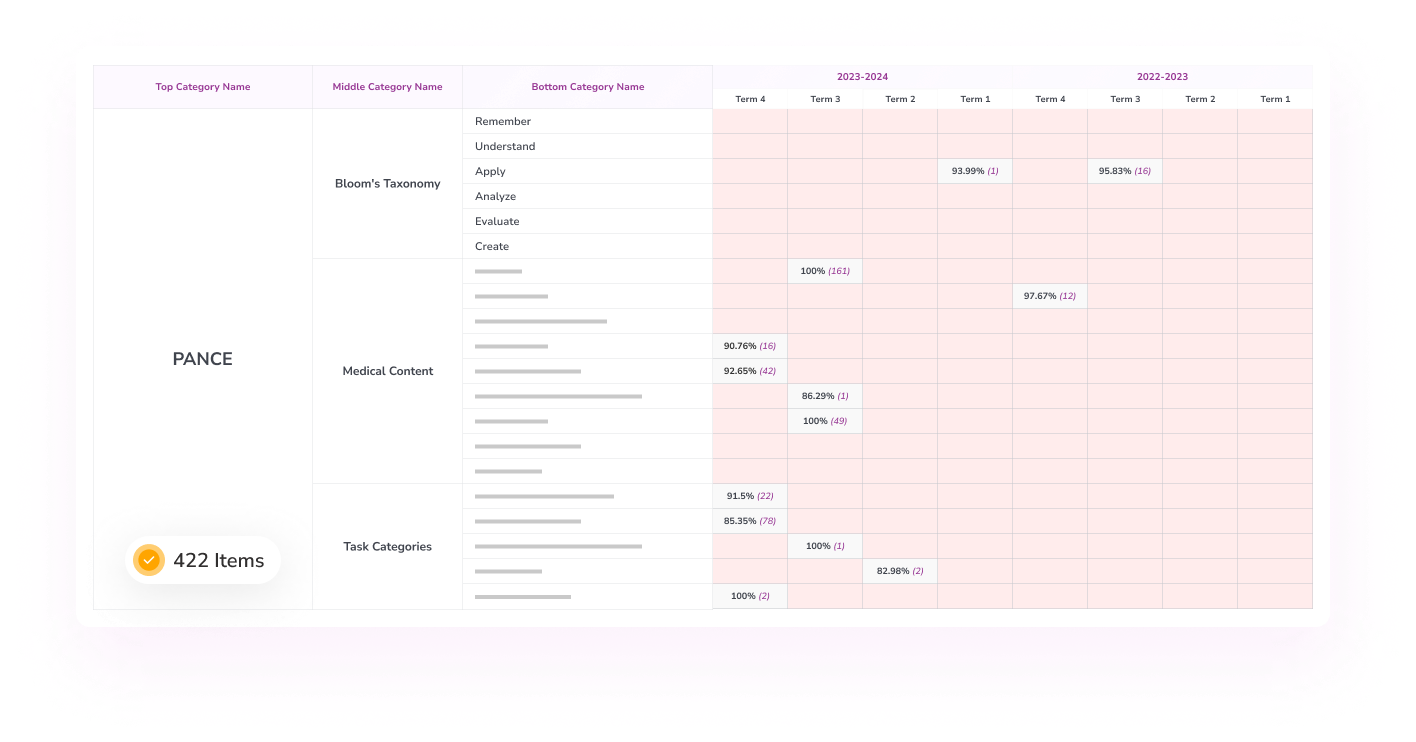
Before CompetencyGenie™

Limited assessment data
The institution faced challenges in evaluating its curriculum effectively due to having only 422 tagged exam items, resulting in an incomplete and potentially inaccurate understanding of program effectiveness.
Perceived curriculum gaps
With limited data, the curriculum appeared to have numerous gaps, making it challenging to identify specific areas needing improvement.
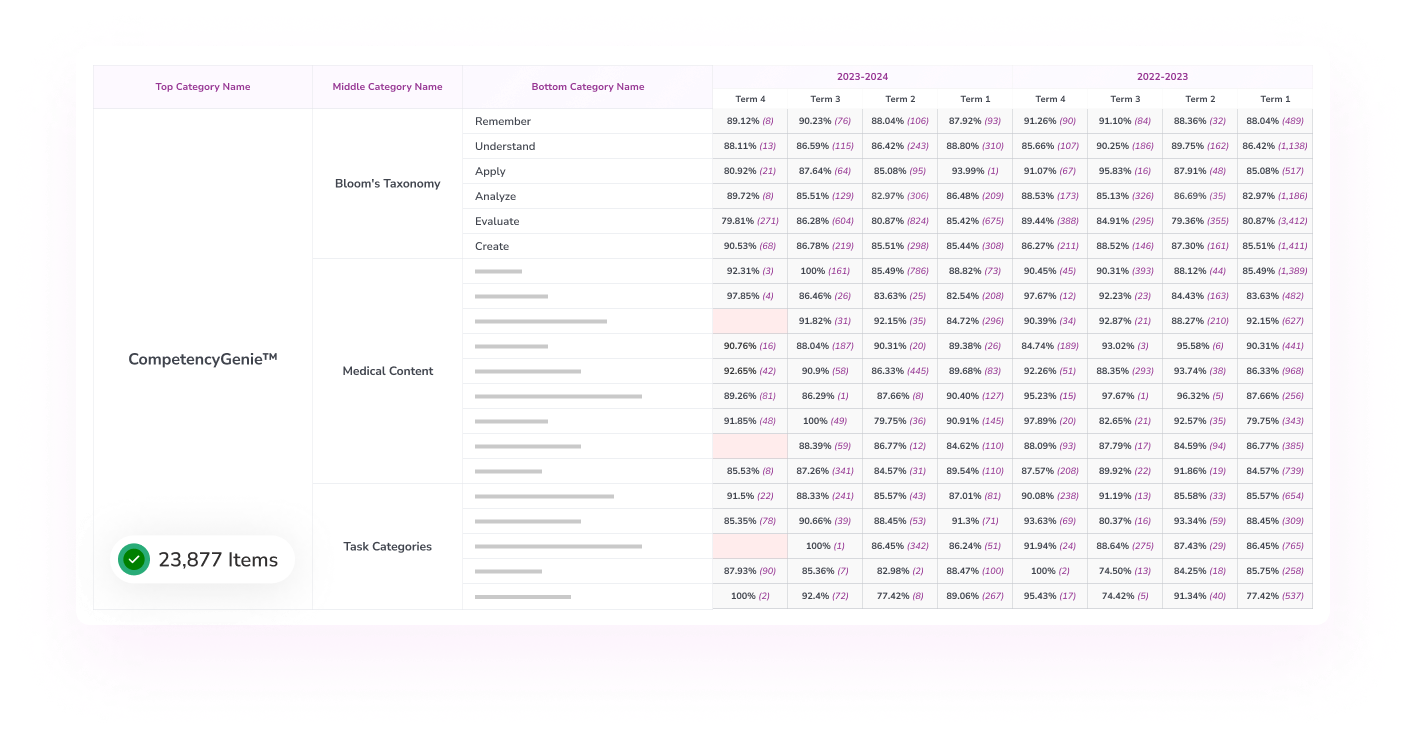
After implementing CompetencyGenie™

Extensive assessment data
The institution now benefits from a robust dataset, with 23,877 tagged exam items, enabling a comprehensive and precise evaluation of the curriculum.
Accurate gap identification
With the significantly increased data, the institution accurately identified only 3 gaps in the current academic term, allowing for timely corrective actions and ensuring a cohesive curriculum by the term’s end.
Efficient self-study preparation
Detailed reports generated well in advance of self-study submissions have saved the institution countless hours of manual tagging and report creation, streamlining the accreditation process.
Enhanced focus on improvement
CompetencyGenie™ has automated the labor-intensive tasks of data cleaning and tagging, thereby allowing faculty to concentrate on their primary objective—identifying and enhancing areas within the curriculum.
Curriculum Effectiveness and Gap Analysis: seeing gaps, redundancies, and patterns
Once curriculum and assessment data are connected, programs can begin to see patterns that are difficult to detect in a static document. A Curriculum Effectiveness and Gap Analysis tool by Enflux can help faculty examine coverage, assessment alignment, and student performance together.
Heat maps make it easier to visualize where competencies are introduced, reinforced, and assessed, while gap analysis helps identify areas that may be overrepresented or insufficiently addressed. This gives curriculum committees a more practical way to prioritize discussion and action.

Curriculum Effectiveness and Gap Analysis dashboard
Once the curriculum is connected. Learning analytics and predictive insights
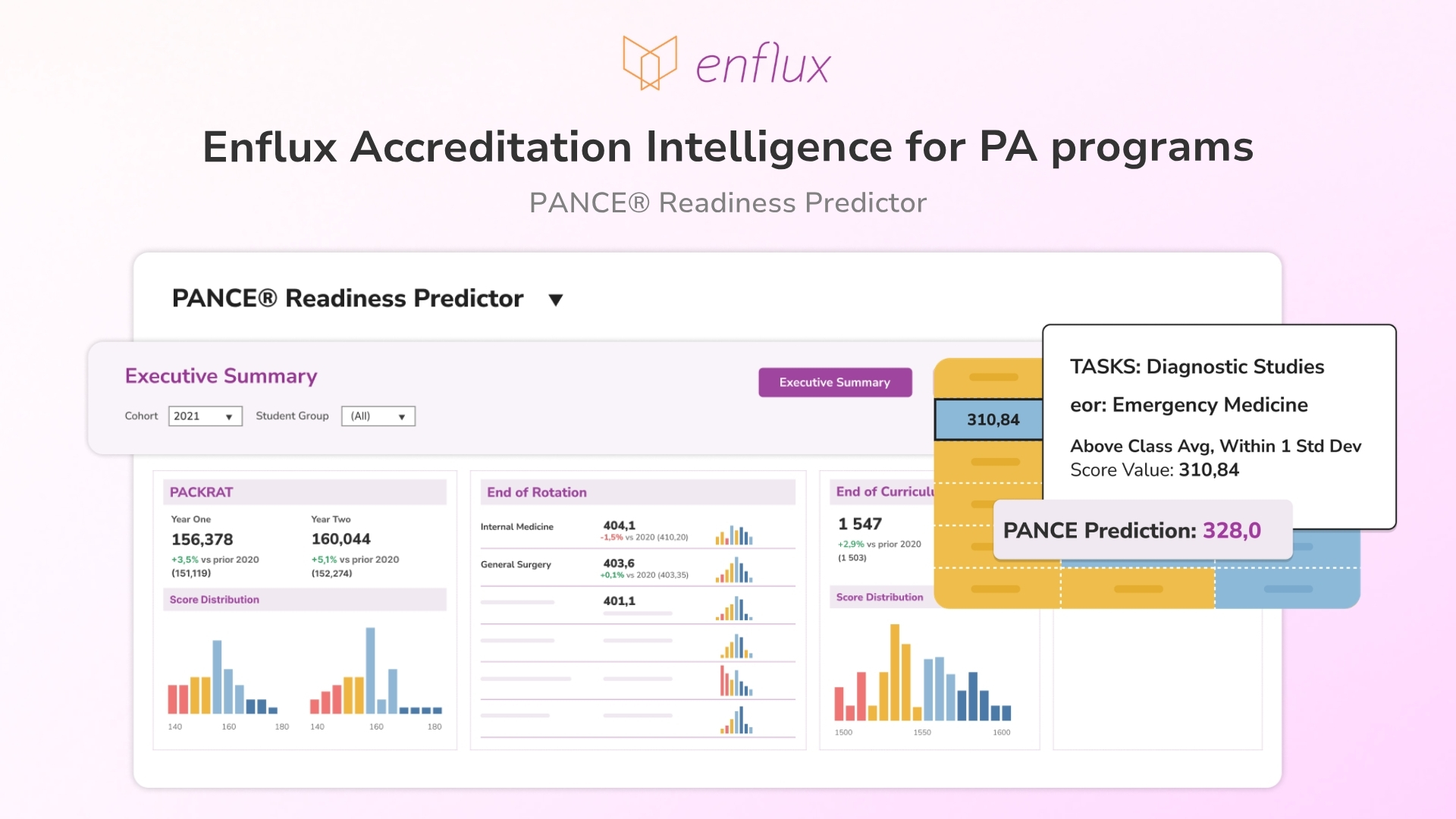
Once a curriculum map is connected to longitudinal assessment evidence, programs can begin asking more advanced questions about student progression, risk patterns, and readiness for high-stakes outcomes. For example, faculty may want to understand whether performance trends across End of Course exams, End of Rotation exams, and PACKRAT are associated with later PANCE® readiness.
The PANCE® Readiness Predictor within Enflux Accreditation Intelligence for PA programs is designed for the next stage of program analytics. It uses longitudinal assessment data to help programs identify students who may need earlier support before graduation.
Building a connected curriculum for continuous improvement
Curriculum mapping for PA programs is not just about showing that content exists. It is about helping faculty understand whether the curriculum is intentionally sequenced, appropriately assessed, aligned to standards, and producing the outcomes students need.
When the map is disconnected, curriculum review becomes slow, reactive, and heavily manual. When the map is connected, faculty can see the relationship between courses, competencies, assessments, outcomes, and accreditation expectations in one place.
That shift changes the conversation. Instead of asking who has the latest spreadsheet, the program can ask what the evidence is showing and what should happen next.
A connected curriculum intelligence doesn’t replace faculty expertise, but it gives faculty better evidence to make curriculum decisions with confidence, providing a clearer, more sustainable way to connect curriculum design, student performance, ARC-PA accreditation, and continuous improvement.
Bring your PA curriculum into one connected view
See how Enflux helps PA programs move from static curriculum documentation to connected curriculum intelligence with CompetencyGenie™, gap analysis, and future-ready predictive insights.