

From Assessment Data to PANCE Readiness: How Predictive Analytics Helps PA Programs Intervene Earlier
PA faculty are not short on data. They are short on time.
End of Rotation™ (EOR™), End of Curriculum™ (EOC™), PACKRAT®, and PANCE® results may sit in separate reports, use different scoring approaches, and arrive at different points in the program. The evidence needed to identify a concerning pattern may already exist, but finding it across multiple reports can slow faculty review.
Faculty do not want to wrestle with another complex interface. They need to answer a small set of high-stakes questions quickly:
- Which students may need support before graduation?
- What evidence is driving that concern?
- What action should happen next?
Predictive analytics for PA programs can help by connecting assessment patterns over time and identifying students whose performance warrants closer faculty review. The prediction is not the decision. It is a clearer starting point for advising, student intervention, and documented follow-through.
Why PA programs can miss students who appear to be on track
Most remediation policies begin with a program-defined performance threshold. This approach identifies students who fall below the established line, but it may not capture students who remain slightly above it across multiple assessments.
Dr. Shaun Grammer described this pattern at the University of Nebraska Medical Center PA Program. Students who repeatedly scored in the mid-70s remained above the program’s 73% passing threshold and therefore did not trigger remediation. After several unexpected first-attempt PANCE failures, the program added a separate high-risk-but-passing review category that offered lighter, individualized support.
The 73% threshold is specific to that program and should not be interpreted as a recommended national cutoff. The broader lesson is relevant to any assessment committee: passing and readiness are related, but they are not identical questions.
Watch the complete on-demand series: PA accreditation intelligence with Dr. Shaun Grammer
What should predictive analytics help PA faculty answer?
Useful predictive analytics for student retention should reduce analytical friction. It should not simply give faculty more columns to interpret. It should organize existing evidence around the decisions faculty already need to make.
A PANCE readiness view should help a PA program answer:
- Which students show a repeated pattern that may warrant earlier review?
- Is the signal based on one result or a trajectory across multiple assessments?
- How does the student’s performance compare with relevant cohort and historical patterns?
- What additional academic or clinical evidence should faculty consider?
- What support, follow-up, and outcome measures should be documented?
The goal is not to average unlike scores or treat every assessment as interchangeable. Each measure must be interpreted according to its intended use.
For example, PAEA describes PACKRAT as a self-assessment tool and does not recommend a passing grade for it. PAEA also advises programs to interpret PACKRAT results carefully and use them with other data points. EOR exams, meanwhile, are one component of the broader evaluation of a supervised clinical practice experience, and programs establish their own performance standards. PAEA’s PACKRAT scoring guidance, PAEA’s EOR scoring guidance.
A discrepancy among assessments is not proof that a student will struggle on PANCE. It is a reason to review the student’s performance more closely.
Research supports the value of examining assessment evidence longitudinally. A 2026 multi-institutional study analyzed EOC and PANCE outcomes for 789 students from 2021–2023 graduating cohorts across six PA programs. The researchers found a strong correlation between EOC and PANCE scores (r = 0.709). This finding supports using EOC as one meaningful input in PANCE readiness analysis, but it does not make a single EOC result a certain forecast of future performance. Study published in the Journal of Physician Assistant Education.
How the PANCE Readiness Predictor supports earlier advising
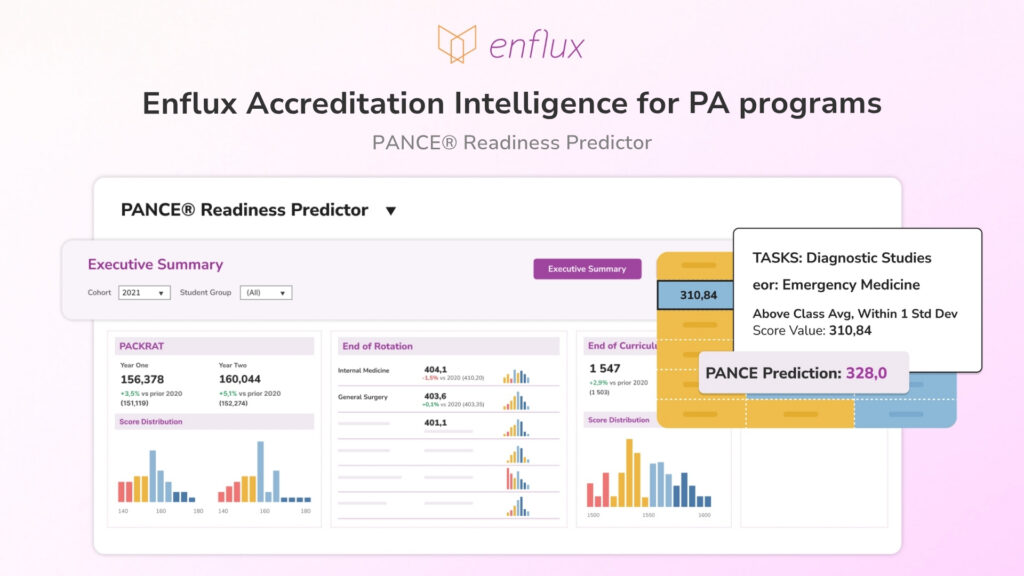
The PANCE Readiness Predictor within Enflux Accreditation Intelligence for PA Programs brings EOR, EOC, PACKRAT, and PANCE data into student- and cohort-level views.
Using available in-program assessment data, it generates a predicted PANCE score before graduation and places that estimate alongside the student’s longitudinal performance. Faculty can examine the prediction in context instead of treating it as a stand-alone risk label.
One connected view instead of four separate reports
Faculty should not have to reconcile multiple exports or search through dense spreadsheets to determine whether a student is improving, remaining flat, or beginning to fall behind relevant comparison groups.
A connected view reduces preparation time and allows the advising conversation to begin with the performance pattern itself. Faculty can then investigate the assessments contributing to the signal and consider other relevant evidence from the student’s record.
A prediction presented with context
A predicted score can make an abstract risk indicator more concrete. It can help faculty and students see:
- Where the student may be headed based on available evidence
- How the estimate relates to the current PANCE passing standard
- Which results are influencing the prediction
- Which upcoming assessments could serve as near-term checkpoints
The estimate should never be presented as a guarantee. Faculty must review the student’s broader academic and clinical record, interpret the signal, and determine whether support is appropriate.
The model provides decision support. Faculty provide academic judgment.
How can PA programs move from prediction to documented action?
Higher education predictive analytics for student success creates value only when a potential risk signal leads to a structured decision and follow-up process.
A practical PANCE readiness workflow follows four stages:
- Signal
- Faculty review
- Documented support
- Reassessment
- Surface the signal. Identify a longitudinal performance pattern that may warrant attention.
- Review the evidence. Ask faculty to interpret the signal alongside relevant academic and clinical information.
- Document the response. Record the support plan, responsible owner, timeline, and intended outcome.
- Reassess the result. Review subsequent performance and determine whether the support should continue, change, or conclude.
Enflux’s ActionPlans® Management System can support this workflow by helping programs document decisions, assign responsibility, monitor follow-up, and retain evidence of outcomes.
This documented process can also contribute to ongoing program self-assessment under ARC-PA Standard C1.01, which includes collecting data, critically analyzing findings, drawing conclusions, and creating self-improvement action plans.
A signal becomes useful when it leads to an accountable response and reassessment, not when it remains another score in another report.

Earlier insight without more analytical friction
PA programs already collect much of the data needed to examine PANCE readiness. The challenge is turning that data into a view faculty can use efficiently, without rebuilding the evidence for every student or every review cycle.
Enflux Accreditation Intelligence for PA Programs is designed to reduce that friction. It connects longitudinal assessment evidence, the PANCE Readiness Predictor, and documented follow-through so faculty can spend less time preparing data and more time deciding how to support students.
A predictive analytics platform does not replace faculty expertise or determine a student’s future. It helps faculty recognize the right question earlier, while there is still time to investigate the evidence and act.
Bring your PA program data into one connected view
See how Enflux Accreditation Intelligence helps PA programs connect assessment, student performance, curriculum, and accreditation evidence to answer critical questions faster and act with greater confidence.